
Is Wall Street Buying Up All the Homes in America?
For Buyers Laura Miller Edwards Realty Group December 7, 2023
For Buyers Laura Miller Edwards Realty Group December 7, 2023
If you’re thinking about buying a home, you may find yourself interested in the latest real estate headlines so you can have a pulse on all of the things that could impact your decision. If that’s the case, you’ve probably heard mention of investors, and wondered how they’re impacting the housing market right now. That could leave you asking yourself questions like:
To answer those questions, here’s the real story of what’s happening based on the data.
Let’s start with establishing how many single-family homes (SFHs) there are and what portion of those are rentals owned by investors. According to SFR Investor, which studies the single-family rental market in the United States, there are eighty-two million single-family homes in this country. But how many of them are actually rentals?
According to data shared in a recent post, sixty-eight million (82.93%) of those homes are owner-occupied – meaning the person who owns the home lives in it. If you subtract that sixty-eight million from the total number of single-family homes (82 million), that leaves just about fourteen million homes left that are single-family rentals (SFRs).
Do institutional investors own all of those remaining fourteen million homes? Not even close. Let’s take it one step further. There are four categories of investors:
These categories show that not all investors are large institutional investors. To help convey that even more clearly, here are the percentages of rental homes owned by each type of investor (see chart below):
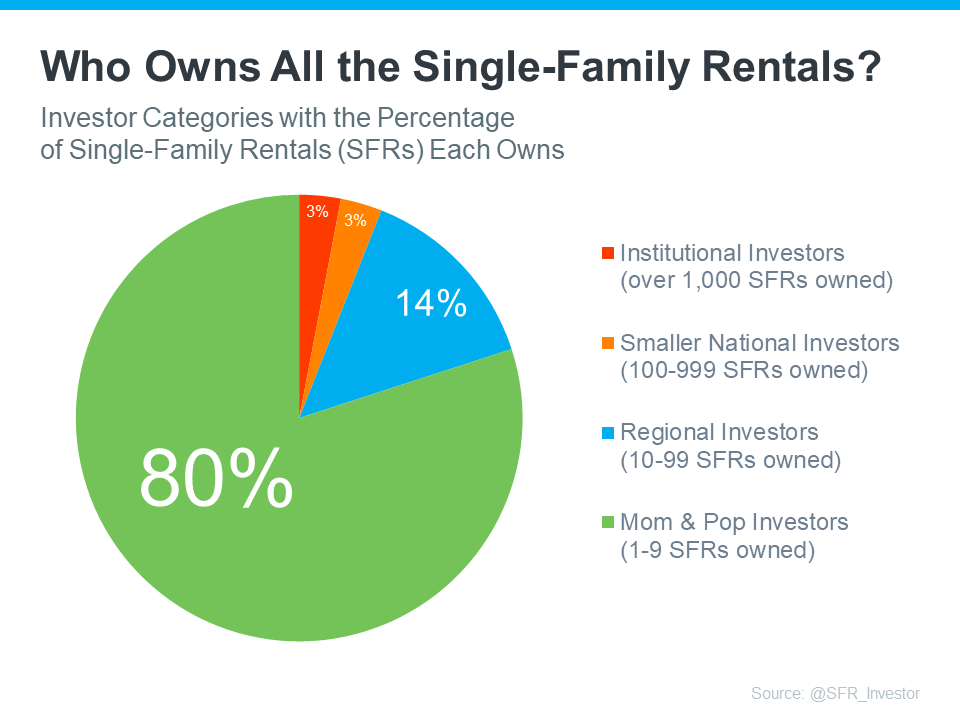
As you can see in the chart, despite what the news and social media would have you believe, the green shows the vast majority are not owned by large institutional investors. Instead, most are owned by small mom & pop investors, like your friends and neighbors.
What’s actually happening is, that there are people out there, just like you, who believe in homeownership, and they view buying a home (or a second home) as an investment. Maybe they saw an opportunity to buy a second home over the last few years to use it as a rental and generate additional income. Or maybe they just decided to keep their first house rather than sell it when they moved up.
So, don’t believe everything you read or hear about institutional investors. They aren’t buying up all the homes and making it impossible for the average person to buy. That’s just not what the numbers show. Institutional investors are actually the smallest piece of the pie chart.
While it’s true that institutional investors are a player in the single-family rental marketplace, they’re not buying up all of the houses on the market. If you have other questions about things you’re hearing about the housing market, let’s connect so you have an expert to give you the context you need.
This blog post previously appeared on https://www.simplifyingthemarket.com/en/2023/11/27/is-wall-street-buying-up-all-the-homes-in-america?a=106260-312309902871c1f0d820820f58bf8fde. The information contained, and the opinions expressed, in this article are not intended to be construed as investment advice. Keeping Current Matters, Inc. and the Laura Miller Edwards Realty Group do not guarantee or warrant the accuracy or completeness of the information or opinions contained herein. Nothing herein should be construed as investment advice. You should always conduct your own research and due diligence and obtain professional advice before making any investment decision. Keeping Current Matters, Inc. and the Laura Miller Edwards Realty Group will not be liable for any loss or damage caused by your reliance on the information or opinions contained herein.
Stay up to date on the latest real estate trends.

Mortgage Rates
While you can't control mortgage rates, you can control several things that shape the rate you get.

Community Information
For a little more than one acre, Glover Park carries a surprising amount of Marietta’s fall social calendar.

Pricing
Selling your house this fall is absolutely doable. Here's what you need to know about this time of year.

First Time Home Buyers
With remote work, where you live can be your decision instead of your employer's. And that puts more affordable places within reach.

Selling Tips
Most home sales still close, and the biggest thing that could get in the way of yours is the one thing you can actually do something about.

For Sellers
Multi-generational homebuying is on the rise.

Community Information
Fall in Downtown Cartersville is best enjoyed when you treat the historic district as one connected destination.

Home Buying
Should you buy your next home before you sell or sell your current house before you start looking?

Affordability
Today's home prices have a lot of buyers wondering if there’s even anything out there that’s in their budget.
Get assistance in determining current property value, crafting a competitive offer, writing and negotiating a contract, and much more. Contact us today.