
What Credit Score Do You Really Need To Buy a Home?
Buying Tips Laura Miller Edwards Realty Group August 6, 2025
Buying Tips Laura Miller Edwards Realty Group August 6, 2025

According to Fannie Mae, 90% of buyers don’t actually know what credit score lenders are looking for, or they overestimate the minimum needed.
Let that sink in. That means most homebuyers think they need better credit than they actually do – and maybe you’re one of them. And that could make you think buying a home is out of reach for you right now, even if that’s not necessarily true. So, let’s look at what the data really says about credit scores and homebuying.
There’s no universal credit score you absolutely have to have when buying a home. And that means there’s more flexibility than most people realize. Check out this graph showing the median credit scores recent buyers had among different home loan types:
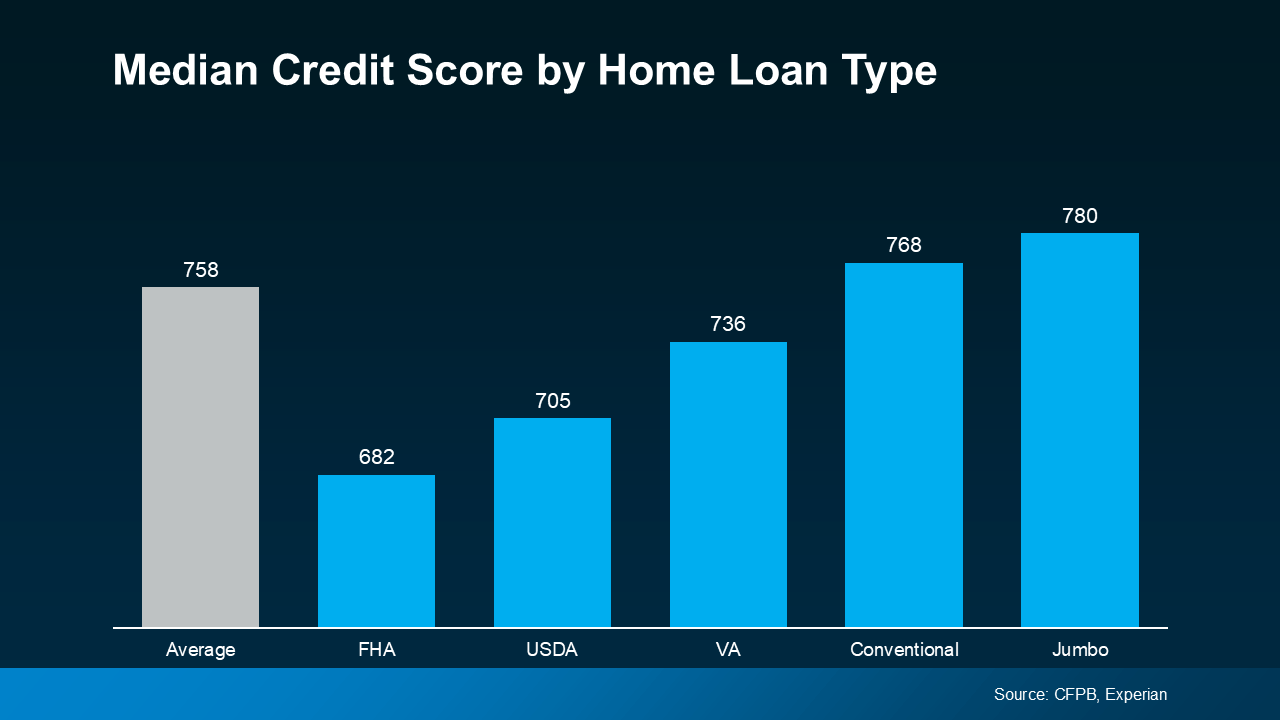 Here's what’s important to realize. The numbers vary, and there’s no one-size-fits-all threshold. And that could open doors you thought were closed for you. The best way to learn more is to talk to a trusted lender. As FICO explains:
“While many lenders use credit scores like FICO Scores to help them make lending decisions, each lender has its own strategy, including the level of risk it finds acceptable. There is no single ‘cutoff score’ used by all lenders, and there are many additional factors that lenders may use . . .”
When you buy a home, lenders use your credit score to get a sense of how reliable you are with money. They want to see if you typically make payments on time, pay back debts, and more.
Your score can impact which loan types you may qualify for, the terms on those loans, and even your mortgage rate. And since mortgage rates are a big factor in how much house you’ll be able to afford, that may make your score feel even more important today. As Bankrate says:
“Your credit score is one of the most important factors lenders consider when you apply for a mortgage. Not just to qualify for the loan itself, but for the conditions: Typically, the higher your score, the lower the interest rates and better terms you’ll qualify for.”
That still doesn’t mean your credit has to be perfect. Even if your credit score isn’t as high as you’d like, you may still be able to get a home loan.
And if you talk to a lender and decide you want to improve your score (and hopefully your loan type and terms too), here are a few smart moves according to the Federal Reserve Board:
Your credit score doesn’t have to be perfect to qualify for a home loan. But a better score can help you get better terms on your home loan. The best way to know where you stand and your options for a mortgage is to connect with a trusted lender.
This blog post previously appeared on https://www.simplifyingthemarket.com/en/2025/07/30/what-credit-score-do-you-really-need-to-buy-a-home?a=106260-312309902871c1f0d820820f58bf8fde. The information contained, and the opinions expressed, in this article are not intended to be construed as investment advice. Keeping Current Matters, Inc. and the Laura Miller Edwards Realty Group do not guarantee or warrant the accuracy or completeness of the information or opinions contained herein. Nothing herein should be construed as investment advice. You should always conduct your own research and due diligence and obtain professional advice before making any investment decision. Keeping Current Matters, Inc. and the Laura Miller Edwards Realty Group will not be liable for any loss or damage caused by your reliance on the information or opinions contained herein.
Stay up to date on the latest real estate trends.

Senior Market
Staying or moving can both be good choices. What matters most is finding the place where you'll feel comfortable for years to come.

Agent Value
Choosing the right Realtor is about more than finding someone who can open a door.

For Sellers
Today, more than 4 in 10 active listings have had at least 1 price cut.

Mortgage Rates
While you can't control mortgage rates, you can control several things that shape the rate you get.

Community Information
For a little more than one acre, Glover Park carries a surprising amount of Marietta’s fall social calendar.

Pricing
Selling your house this fall is absolutely doable. Here's what you need to know about this time of year.

First Time Home Buyers
With remote work, where you live can be your decision instead of your employer's. And that puts more affordable places within reach.

Selling Tips
Most home sales still close, and the biggest thing that could get in the way of yours is the one thing you can actually do something about.

For Sellers
Multi-generational homebuying is on the rise.
Get assistance in determining current property value, crafting a competitive offer, writing and negotiating a contract, and much more. Contact us today.